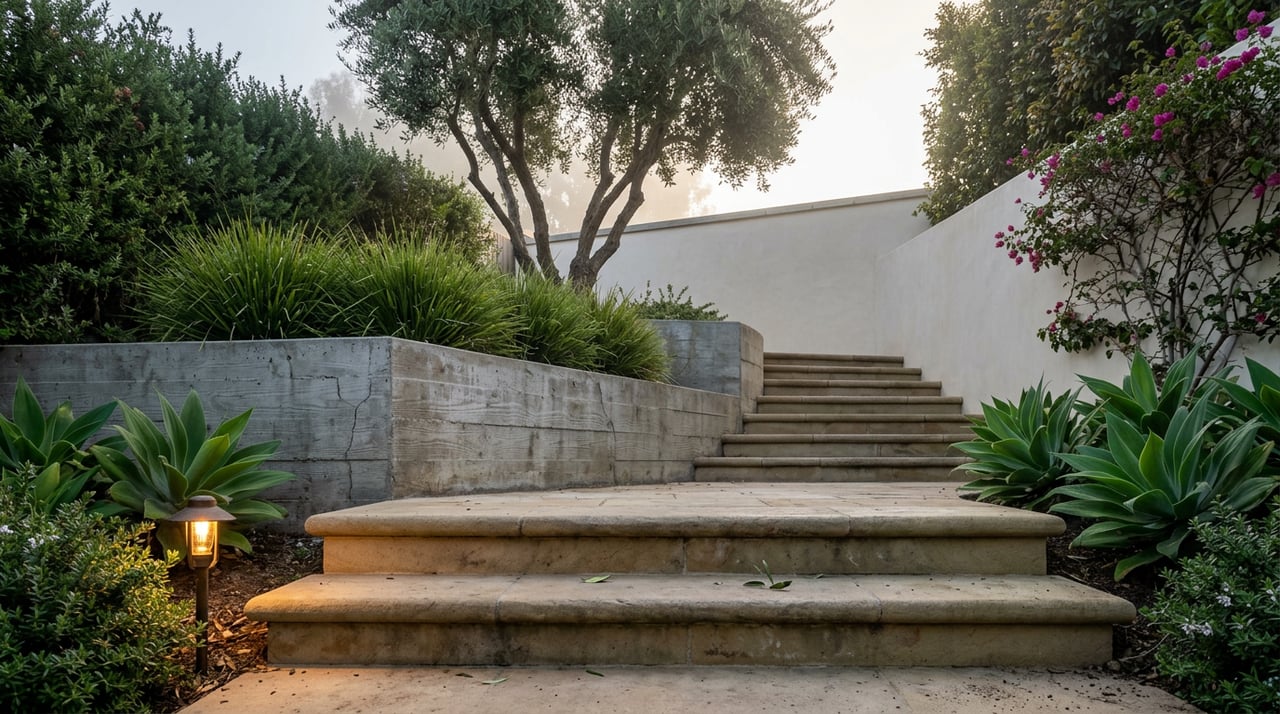
The marine layer hasn't burned off yet when the first cars start filling the free street parking near 872 Poppy Avenue. It's just past seven, and the only sound in the canyon below is running water, the kind that surprises people who assume Southern California doesn't have creeks. A short walk away, at the corner of Marguerite and Pacific Coast Highway, folding tables are still going up. Neither event has technically opened yet. Both will be finished, or close to it, by the time most of Newport Beach is having its second coffee.
That timing isn't an accident, and it isn't obvious from either place on its own. The real thing worth knowing about a Saturday in Corona Highlands is how these two fixtures, a canyon trail and a produce market that have nothing to do with each other, end up sharing the same few hours and the same few blocks. Get the order wrong and you're hiking in afternoon heat or shopping a picked-over market. Get it right and you've built a morning that no listing photo or generic neighborhood guide ever mentions.
The Rule Nobody Reads the Sign For
Buck Gully Trail looks like a hiking trail. It functions, for part of its length, like a one-way street.
Since October 2019, mountain bikes on Buck Gully have been restricted to uphill travel only. That single rule changed the physical experience of the trail more than any signage about wildlife or erosion could. Before it, bikes and hikers shared the same narrow singletrack in both directions, which meant a fast descent could meet a family walking uphill with a stroller around a blind curve. Now the bikes only climb. Hikers coming down don't have to listen for a rider behind them on the way back to the car.
It's a small policy footnote, but it's the reason a canyon that draws hikers, trail runners, and cyclists on the same morning still feels calm rather than congested. Nobody standing at the trailhead reads a sign explaining it. They just notice, eventually, that the ride down never comes.
What the Trailhead Doesn't Tell You
The trailhead itself is easy to miss if you don't already know it. There's no gate, no visitor center, no bathroom. The City of Newport Beach points hikers toward the restrooms at the nearby Oasis Senior Center if they need one before setting out, because there isn't another option on the trail itself. Parking is free and on-street, in a residential neighborhood, which means the unwritten rule is to be quiet about it and mind the fire lanes.
From there, Buck Gully runs about five miles out and back if you take the full singletrack, with roughly 500 feet of elevation gain and three narrow aluminum bridges crossing the creek. Those bridges weren't built in place. They were helicoptered in, piece by piece, because there was no other way to get the materials down into the gully. The canyon functions as a wildlife corridor, and hikers who go early enough sometimes catch matted grass off to the side of the trail where deer have bedded down overnight, or catch a glimpse of the bobcats the reserve is known to host.
None of this shows up on a map. It shows up if you've walked it enough times to notice.
Two Kinds of Saturday Regulars
Most people treat Buck Gully as a solo errand: earbuds in, out and back, done before the day gets hot. But there's a second group of regulars who treat it differently, and most first-time hikers never find out they exist.
The Newport Beach Chamber of Commerce runs a recurring NAVIGATE hike series that uses the Buck Gully trailhead as its meeting point, turning what's usually a solitary walk into a guided group outing. The Sierra Club has organized its own hikes through the gully as well, often extending the route into a longer loop that climbs back along the street for ocean views before returning. Docent-led walks through the canyon, when they're offered, tend to slow the pace down considerably and turn a fitness errand into something closer to a nature lesson, with detail on the native plants and creek ecology that a solo hiker would walk right past.
If you've only ever done Buck Gully alone, you've seen the trail. You haven't necessarily seen what the people who know it best get out of it.
The Market on the Other End of the Loop
By the time a Buck Gully hiker is heading home, the Corona del Mar Certified Farmers Market is hitting its stride. It runs every Saturday, rain or shine, from 9 a.m. to 1 p.m., at Marguerite and PCH, and it's been doing that since 1996. That's not a pop-up or a seasonal event. It's closer to thirty years of the same corner, the same rhythm, at this point.
What sets it apart from a generic farm stand isn't just the produce, though the market draws from growers whose fruits and vegetables you often won't find at other markets in the area. It's the mix: prepared foods, honey, fresh fish, and flowers alongside the produce tables, which means a Saturday morning stop can cover most of a week's shopping list in one pass, on foot, without a second errand later. Parking is limited, on-street and in a small lot, which is its own argument for arriving on foot from somewhere close by rather than driving in.
Why the Timing Is the Whole Trick
Here's the part that actually matters if you live in Corona Highlands rather than just visiting it. The trail is best hit early, while the marine layer is still holding and before the exposed sections of the canyon start to warm. The market is best hit toward its later hours, once the earliest arrivals have thinned out but before the best of the fish and flowers are gone at 1 p.m. Those two windows don't overlap. They sit back to back, canyon first, market second, with just enough distance between Poppy Avenue and the corner of Marguerite and PCH to make the two feel like one continuous morning rather than two separate errands.
That's the piece a first-time visitor to either spot doesn't know to look for. They experience the trail or the market as a destination. Someone who's lived on the terraced streets above the gully for a few years experiences the two as one Saturday, sequenced without thinking about it, the same way you don't think about which route you take to get coffee.
It's a small thing. It's also the kind of small thing that only shows up after enough repetition to notice, which is a fair description of what living somewhere actually means, as opposed to just knowing its address.
If a market corner that's held its ground since 1996 and a one-way rule from 2019 sound like a strange pair of facts to hang a neighborhood on, that's the point. The generic version of Corona Highlands is ocean breezes and private beach access. The real version includes a specific Saturday morning that took decades and one traffic decision to get right.
If you're curious what else about Corona Highlands doesn't show up in the usual write-ups, or you'd like a conversation grounded in this level of detail about buying or selling on these hillside streets, reach out to Casey Lesher to request a confidential market consultation.