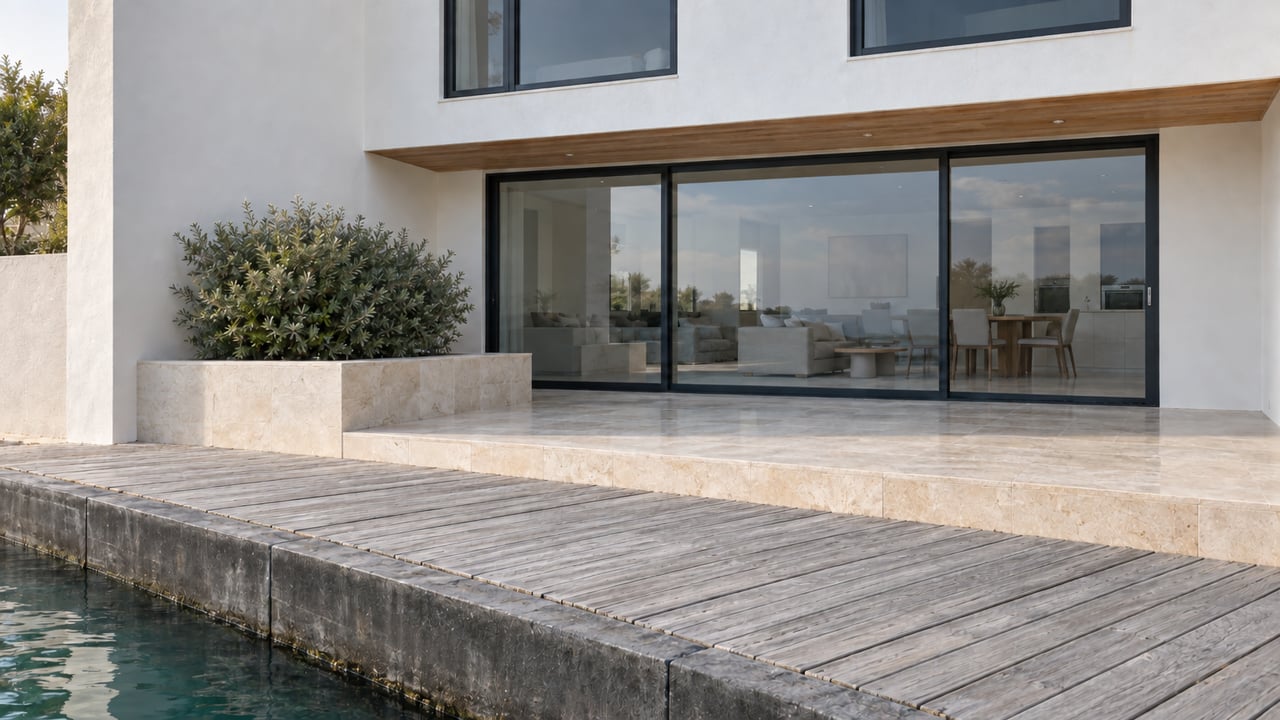
A bayfront listing on Via Lido Nord shows a price, a square footage, and a dock that holds a 45-foot boat. What the listing doesn't show is that the dock itself isn't real estate at all. It's a permit to use public water, issued by the City of Newport Beach on behalf of the State of California, and that permit is currently priced well below what state regulators say it's worth.
This matters right now because the agency that oversees California's public trust lands looked at how Newport Beach manages its harbor and did not like what it found. For anyone comparing Lido Isle to other Newport Harbor waterfront neighborhoods, that finding changes the math on what a private dock is actually worth, and what it might cost to keep.
What Actually Conveys at Closing
On most of Newport Harbor's bayfront, private ownership stops at or near the bulkhead, the retaining wall at the back of the lot. Everything on the water side of that line is public tideland, held in trust for the people of California and administered by the City. A homeowner's dock sits on top of that public land under a City-issued pier permit, not as private property carved out of it.
Lido Isle is one of the harbor's most concentrated examples of this arrangement. The island holds roughly 800 homes, and about 250 of them sit on the waterfront with private docks, which is a meaningful share of the more than 850 permitted residential piers the City administers along its entire bayfront. Every one of those piers, on Lido Isle or anywhere else in the harbor, sits on the same public trust land, and the rules governing them are being rewritten at the same time.
The Two Lines That Set the Real Price
What separates a $5 million Lido Isle bayfront home from a $15 million one isn't always square footage. It's frequently the gap between two surveyed lines: the bulkhead line, where the property stops, and the pierhead line, which marks how far into the water a dock is permitted to extend. A parcel with a wide gap between those two lines can berth a much larger vessel than a parcel with a narrow one, even if the houses behind them are architecturally identical.
Recent bayfront listings on Lido Isle illustrate the range directly. Some private docks are built to hold a 45-foot vessel plus a smaller Duffy for harbor cruising. Others are rated for a 60-foot yacht. That difference in vessel capacity is a function of the harbor lines behind the house, not the floor plan in front of it, and it belongs on any comparison sheet a buyer builds between two Lido Isle listings that otherwise look similar on paper.
A Rent That Hasn't Moved With the Market
In December 2025, the California State Lands Commission issued a management review of how Newport Beach handles its tidelands. On residential piers specifically, the Commission's staff found that homeowners are currently charged 58 cents per square foot, a rate that may actually be worth as much as double that amount at fair market value. The City of Newport Beach says some pier permit holders sublease their docks without disclosing that income or paying fair market rent to the City.
A Voice of OC report quoted the Commission's staff report as saying the pattern of reducing pier rent through smaller lease areas and lower rates, without updated appraisals, may violate both the granting statute and the California constitution. The City has since committed to a new appraisal and an updated rate structure, which is the process now underway.
The City's Own Timetable
Newport Beach has not disputed the finding. The City's own public explainer on the harbor confirms it is conducting a new independent appraisal of residential pier leases and will update rental rates as a result. Public meetings on the process began in spring 2026, with a comprehensive policy package still headed to the City Council in 2027. The City has also been explicit that no rate increases, transfer restrictions, or other policy changes take effect without a Council vote and public notice, so nothing has changed yet.
That distinction matters for how a buyer should read a current Lido Isle listing. The pier rent shown on a seller's disclosure today is accurate today. It is not a number with a long shelf life. A buyer underwriting a bayfront purchase in 2026 is underwriting a cost that a state agency has already flagged as understated and that a city government has already committed to revisiting.
The same review looked at offshore moorings elsewhere in the harbor, which are a separate permit type from residential piers and typically used by boat owners without waterfront homes. A Voice of OC report says state officials found no issue with the appraisal behind mooring rate increases, but raised concerns that the long-standing practice of privately transferring mooring permits between owners may itself violate the public trust doctrine. That finding doesn't apply to residential pier permits directly, but it signals the same regulatory posture toward every kind of private arrangement layered on top of public water in this harbor.
The Paperwork That Doesn't Follow the Deed
A pier permit is issued to the owner of the property behind it, not to the dock as a standalone asset, which is why it doesn't pass automatically when a house sells. The City requires a transfer application submitted with complete information for both the buyer and the seller, with signatures due at close of escrow, along with a transfer fee. Skipping this step, or assuming it happens automatically because it's part of the same transaction, is the kind of oversight that surfaces after closing rather than before it.
This is a separate process from the Lido Isle Community Association's own annual assessment, which funds the clubhouse, tennis courts, and private beaches and has nothing to do with what the City charges for the pier itself. A buyer budgeting for a bayfront purchase is looking at two distinct recurring costs from two distinct entities, one of which is currently under state-ordered review.
Reading a Bayfront Listing With This in Mind
None of this means Lido Isle's waterfront is a bad bet. Demand for the island's roughly 250 waterfront addresses has stayed strong through 2026, with interior homes off the water still clearing the mid four to low five million range and premium bayfront frontage on Via Lido Soud and Via Lido Nord reaching well past $15 million. What it means is that the dock behind the house is a variable, not a constant, and pricing it correctly requires more than reading the listing sheet.
A buyer comparing two Lido Isle bayfront homes at similar square footage should ask what vessel size the dock is actually rated to hold, what the current annual pier rent is in writing, and whether that dock has ever been subleased. A seller should have those answers ready before the question comes from the buyer's side of the table, since a City-ordered reappraisal already in motion is not a detail either party wants surfacing for the first time during escrow.
Before removing contingencies on a Lido Isle bayfront purchase, get in writing:
- The current annual pier rent, and whether it has changed in the last two years
- The permitted vessel size, based on the gap between the bulkhead and pierhead lines
- Confirmation that no prior sublease of the dock exists without City disclosure
- The Lido Isle Community Association's separate annual assessment, distinct from any City pier charge
A Few Questions Worth Asking Early
Does the dock automatically transfer with the title when I buy a Lido Isle bayfront home? No. The dock sits on public tideland under a City permit issued to the property owner. The permit must be formally transferred through a City application, with signatures from both buyer and seller due at close of escrow, along with a transfer fee.
Will my pier rent go up as soon as I close? Not immediately. The City has said no rate increases take effect without a City Council vote and public notice. The appraisal process is already underway in 2026, which is why current low rent shouldn't be treated as permanent.
Is the pier rent the same thing as my HOA dues? No. The Lido Isle Community Association's annual assessment covers the clubhouse, tennis courts, and private beaches. The pier permit rent is a separate charge paid to the City of Newport Beach for use of public tideland, and it's the one currently under state-ordered review.
Understanding what you're actually buying behind a Lido Isle bayfront home, and what the City and State are actively rewriting about it, is exactly the kind of detail worth working through before an offer goes in. Casey Lesher can walk through a specific Lido Isle listing's pier permit, rent history, and harbor line survey with you directly. Request a Confidential Market Consultation to start that conversation.
This article is general information, not legal, tax or financial advice. Consult a qualified professional about your situation.